A
Assess
A 9-metric fitness battery — sprint, jump, agility, core and more — establishes a percentile baseline against Khelo India age & gender norms.

Day-1 baseline
Structured multi-sport coaching for children aged 7–14. We assess, train, and report on the metrics that actually matter — and hand parents a monthly report card that finally answers: is my child improving?
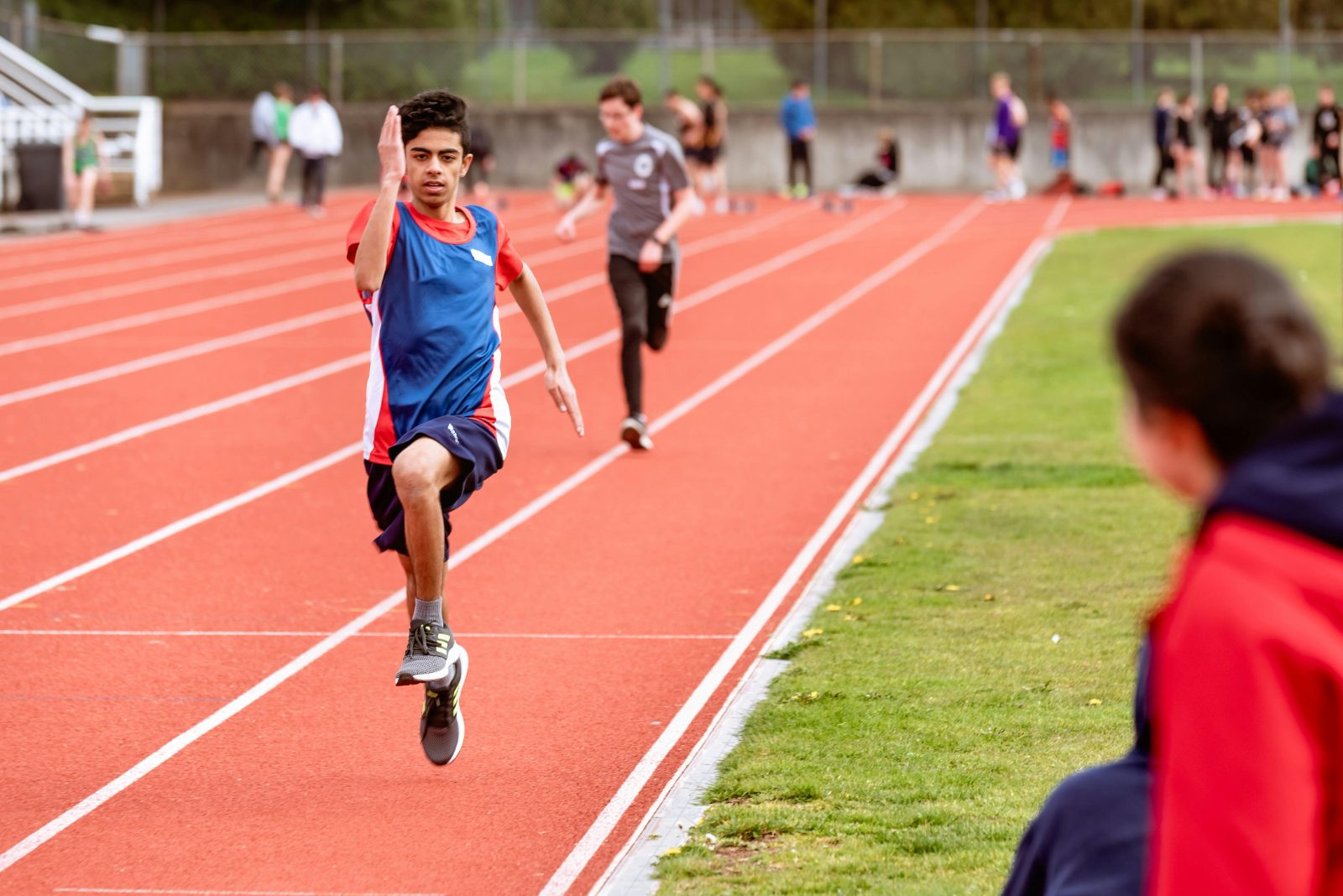
Indian parents have a clear way to know if their child is improving in school: marks, ranks, percentiles. Sport has none of that. A parent pays ₹3,500 a month for a cricket academy and gets a vague "he's improving" — no way to see whether their child is actually getting better, and no way to compare against age-appropriate norms.
It's why so many families drop sport by age 11. Not because the child stopped enjoying it — because the parent stopped being able to see the value.
Over 18 months we read the sport-science literature, studied how world-class youth programmes operate, spoke with paediatric sports physicians and certified coaches — and ran three pilot cohorts with 42 children across two Indore venues. The model works. Pilot kids gained a median 14 percentile points in 12 weeks. 91% completed the full cycle. Parent NPS was 67.
Before we wrote a single drill, we worked through the literature on youth athletic development and the world's most respected youth programmes. Six findings shape every decision Sprata makes.
The AAP, IOC and AOSSM all warn against single-sport specialisation before age 12 — citing higher rates of overuse injury, burnout and early dropout.
Motor patterning, balance and coordination are most receptive between ages 5 and 12 — the "skill-hungry years." Movement learned here is the substrate for every adult sport.
Surveys of NCAA D1 rosters, Olympians and EPL academy graduates consistently find the most successful adults played 2–3 sports through their early teens.
Children who can see their own progress — concrete, age-adjusted, comparable over time — engage more and report higher athletic self-efficacy.
A 1:8 coach ratio produces ~3× more individual interactions per session than 1:25 — and 1:8 is where skill-acquisition curves begin to genuinely accelerate.
The gap is built by how sport is delivered. Measurable progress, body-positive coaching and same-gender cohorts retain girls at near-equal rates to boys.
The more movement patterns a child learns before 12, the better an athlete they become — whichever sport they specialise in later. We start with three foundational sports and add a new one every quarter.
Three sports that together cover roughly 80% of the foundational movement patterns kids 7–14 need.
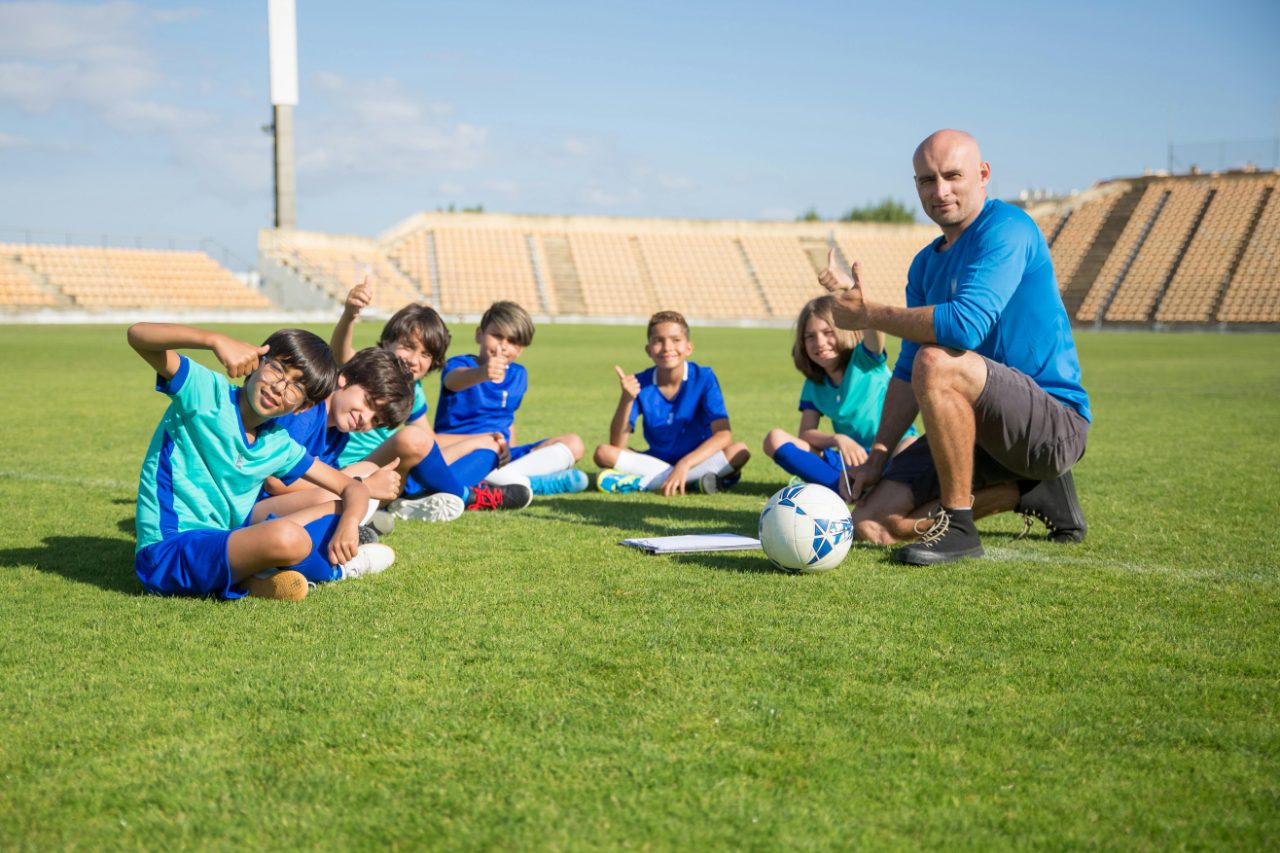
Skill, decision-making, small-sided games. The most-loved sport for most kids.
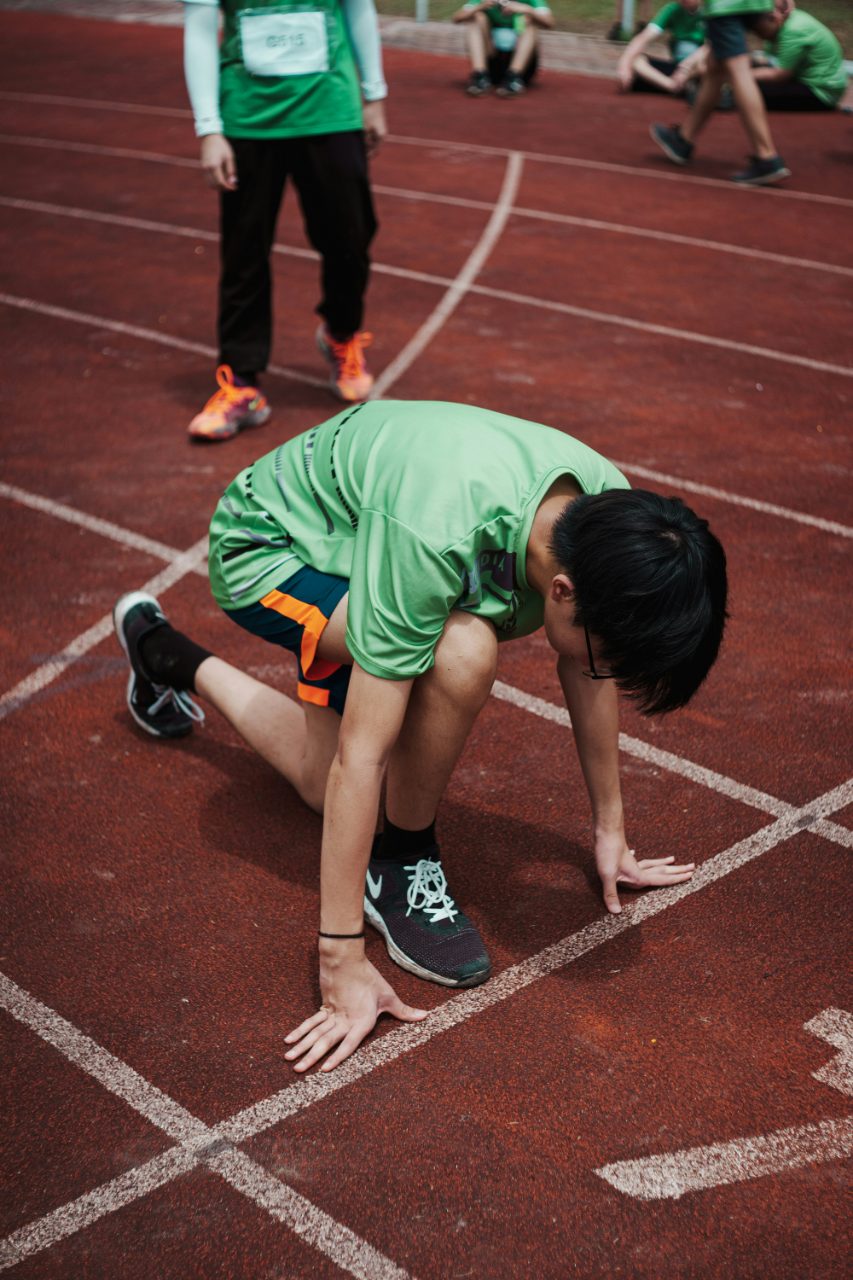
Sprint mechanics, agility, jumps, throws. The foundation under every other sport.

Indian sport. Movement, body awareness, team play. Underrated for kids 7–14.
Four more sports we're committing to add as our coach roster and equipment expand.
Every new sport fills a specific gap in motor literacy. We'll add what makes sense, in the order that gives kids the most value.
Our science-backed method evolves with your child's biological age — focused on mobility, power and coordination, measured every four weeks.
A 9-metric fitness battery — sprint, jump, agility, core and more — establishes a percentile baseline against Khelo India age & gender norms.
Multi-sport sessions 5× a week in small batches, with drills targeting the movement patterns each child's profile says to prioritise.
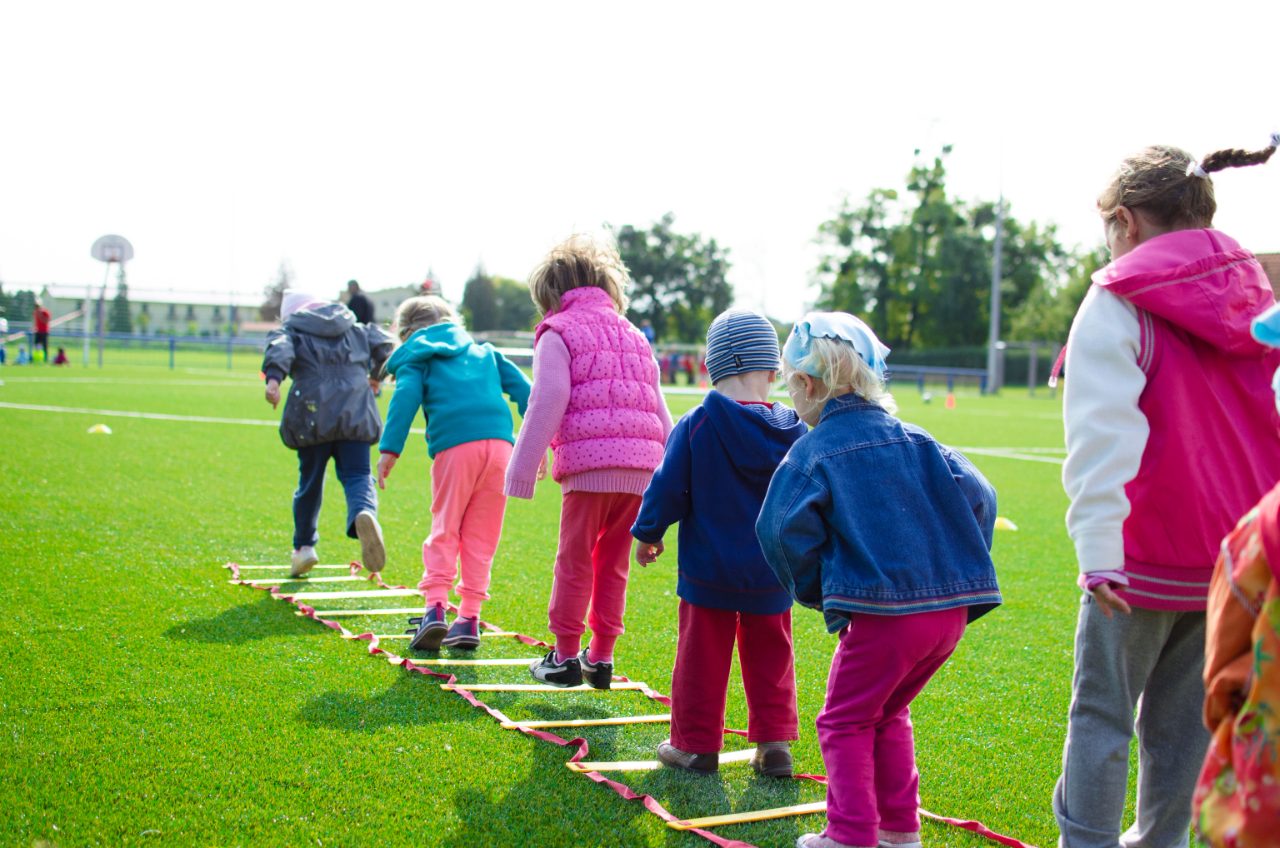
A one-page monthly report card lands on WhatsApp — real numbers, real percentile movement, and the focus areas for next month.
We don't just teach a sport. Every weekly session builds — and every monthly report card measures — the eight outcomes that matter most.
The foundation under every sport, every grade of PE, every adult activity.
Cricket batting, badminton, even handwriting — all rely on it.
The aerobic base that supports learning, focus and energy.
Built through measurable wins, week after week.
Regular activity is strongly linked to fewer sick days at school.
Coordinated movement under instruction trains attention.
Showing up, following structure, completing what you started.
Core strength now means an aligned spine for life.
"Through play, we build."
Four steps. Each one is light. Each one is reversible. You're never locked in.
A two-day weekend camp. Your child does the 5-metric assessment, plays all three sports, and meets the coaches.
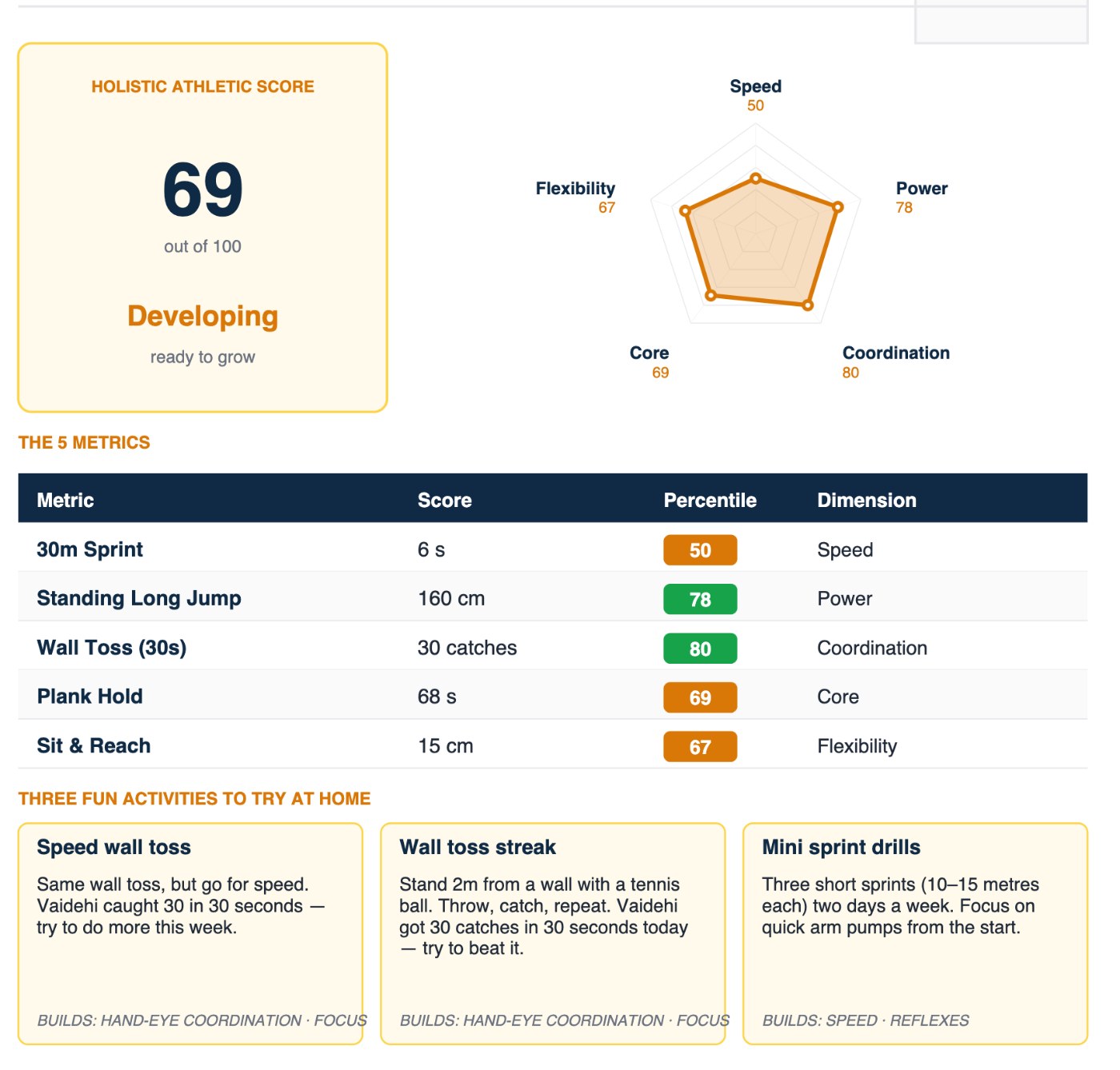
Every camp attendee gets a personalised Sprata Athletic Profile (PDF) showing exactly where they are.
Five sessions a week at a partner indoor turf. 15 kids max. Monday to Friday.
Every month, an updated report shows improvement on 9 metrics. Real numbers, real progress.
Stop guessing. Every Sprata child receives a one-page monthly report — the same idea as a school report card, but for athletic development. You see exactly where your child started, where they are now, and how much they've improved.
Every child sits the same battery on Day 1 and every 4 weeks after — adapted from the Khelo India Youth Games assessment and ACSM Youth Fitness Standards. Every test takes under 60 seconds.
| Metric | Dimension | What it measures | Norm reference |
|---|---|---|---|
| 30m Sprint | Speed | Acceleration and stride mechanics | Khelo India 7–17 yr norms |
| Standing Long Jump | Power | Explosive lower-body power | KIYG 2019 norms |
| Wall Toss (60s) | Coordination | Hand-eye reaction speed | ACSM youth battery |
| Plank Hold | Core | Anterior chain endurance | NSCA youth standards |
| Sit & Reach | Flexibility | Posterior chain mobility | Khelo India |
| 20m Shuttle (Beep) | Aerobic | VO₂max indirect estimate | Léger et al, 1988 |
| Side-Step Agility | Agility | Lateral coordination & quickness | KIYG 2019 |
| BMI Percentile | Growth | Age-adjusted anthropometric tracking | WHO child growth charts |
| Resting Heart Rate | Cardio | Cardiac fitness baseline | AHA pediatric guidelines |
Three pilot cohorts across two Indore venues, late 2024 through early 2026. Every child sat the full 9-metric battery every 4 weeks. Here's what the data showed.
The monthly report is what made my husband come around. He's the kind of dad who needs to see numbers to believe something is working. After two reports, he was the one asking when the next batch starts.
My son was the slowest kid in his PE class. After 12 weeks his 30m sprint went from 7.1 to 6.2 seconds. The number mattered — but his confidence in PE class is what we actually noticed at home.
We've watched what happens to children in programmes that take shortcuts. These six principles are written down so the temptation never reaches us when scale pressure comes.
Multi-sport rotation is non-negotiable — even when parents ask for it. The research on early specialisation is too clear to ignore.
No leaderboards. No "Best of Batch" awards. No public scoring boards. Every child's percentile stays private to their family.
Volumes and intensities follow age-appropriate LTAD guidance. No "more is better" thinking. No grinding 8-year-olds.
Ever. No exceptions. Even for makeup sessions. Even for "just five more minutes." This is the safeguarding bright line.
If a child plateaus or regresses on a metric, the report shows it — and we explain why. We're accountable to the data, not to optics.
A new batch requires a verified, trained coach — not just demand. We'll turn families away before compromising who delivers sessions.
We're new — but we've taken every safety, vetting and insurance step that established programmes take. Here's what every Sprata coach signs up to.
Police verification, identity verification, and two reference checks before any coach is assigned a batch. PCC refreshed annually.
Every coach completes CPR and child-first-aid certification within 30 days of joining. A first-aid kit is on the field every session.
Every enrolled child is covered by personal accident insurance during scheduled sessions. Policy documents on request.
Published, signed and visible at every venue. Includes no-1-on-1 rules, photo-consent protocols and incident reporting.
Maximum 15 kids per batch. A coach-to-child ratio that means every child gets seen, every session.
Vijay Nagar, Super Corridor and Bicholi — chosen for proximity to home and facility quality. Year-round venues.
Our ambition isn't a single batch in a single city. It's to define what measurable, structured kids' multi-sport coaching looks like in Tier-2 India — and scale it to every family who needs it.
"Make measurable, multi-sport coaching the default for every child in Tier-2 India — backed by data parents can finally see."
No pricing pressure, no commitment. Your child plays, we measure, you walk away with their personalised Sprata Athletic Profile — even if you never come back.